
2026: Scale the Process. Keep the Soul.
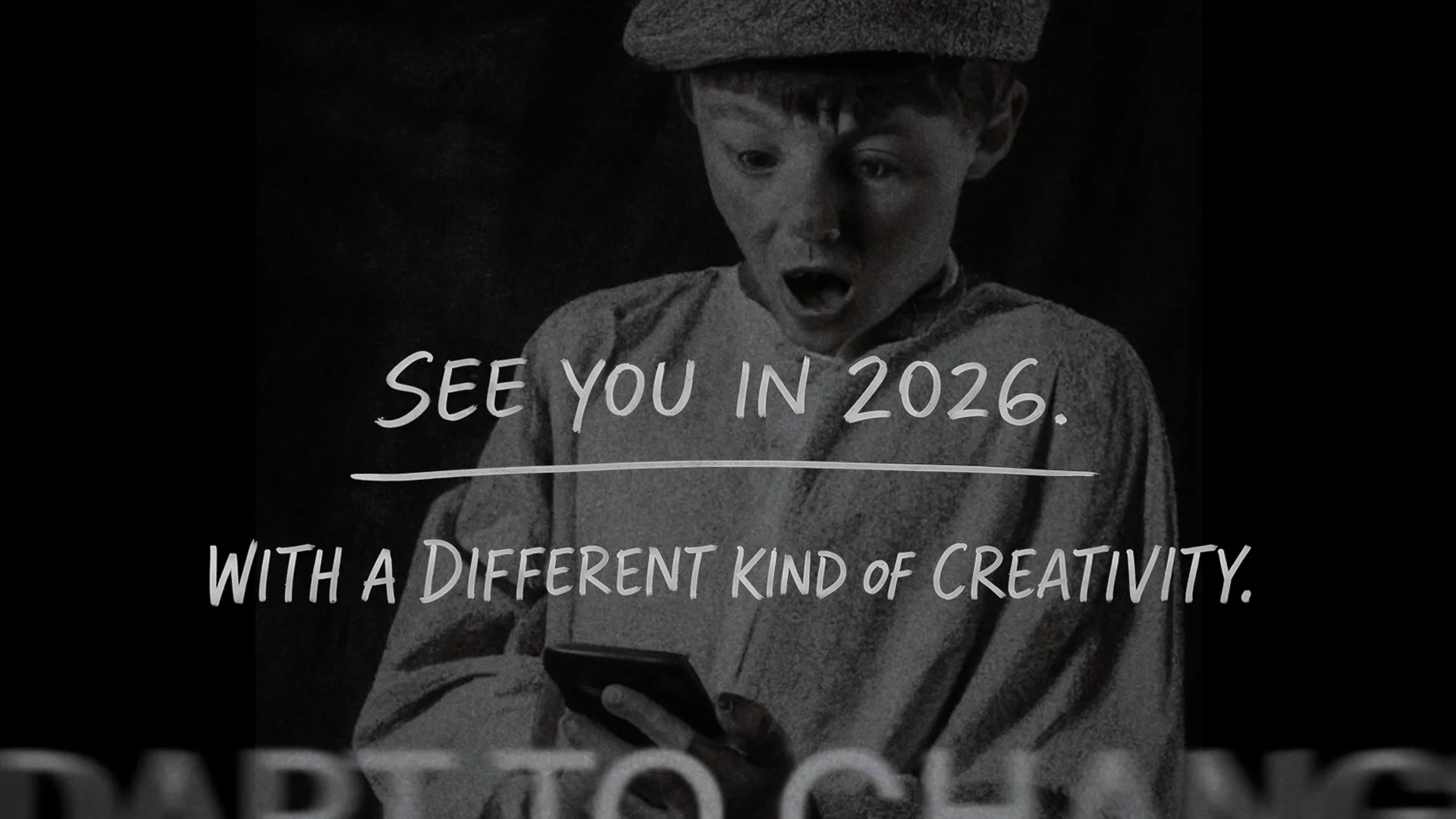
2026 will be the year we stop treating AI as a tool and start running it as a system. For the past few years, we’ve treated it as a powerful new capability, something to test and bolt onto existing workflows. Now we’re entering a phase where it has to be managed as a system, not used as a shortcut.
The experimentation and pilot phase is behind us. AI has moved beyond being a temporary experiment and become a critical element at the center of business strategy. It’s showing up not as a single tool, but as a new layer of production, decision-making, and iteration across the creative process.
What once delivered a competitive advantage has started to look more like infrastructure, similar to electricity or the internet: often invisible, but the moment it’s missing, production slows down and friction shows up everywhere. When it works, it fades into the background. When it doesn’t, the entire operation feels it.
And this shift isn’t happening in theory. Creative professionals have already woven AI tools into their day-to-day workflows, across ideation, drafting, visual exploration, and versioning. The baseline has moved.
So the question is no longer “Do we need it?” The real question for 2026 is this:
How do we manage this technology without stripping creativity of its soul?
1. From Pilot Projects to the Mainstream:
The Experiment Phase Is Over
The last three years have been a real-world sandbox for the creative industry: we generated visuals with generative AI, wrote with large language models, and pushed the speed limits of prototyping. But as we step into 2026, none of this reads as “innovation” anymore. It’s becoming the everyday standard of production.
Here’s the real inflection point: pilot work has given way to scale. We’re no longer using AI only in isolated experiments. We’re placing it at the center of the entire creative process, from ideation to adaptation, from production to versioning. So the question is no longer just “Can we create something?” It’s also: “Can we grow the same idea across different formats and channels, at the same level of quality?”
Yes, this shift is now a prerequisite for staying competitive. But there’s a critical difference: it’s not enough to treat AI as a lever for speed and cost. The real challenge is turning this raw creation capability into a system that is controlled, consistent, and auditable, built specifically for the brand.
In 2026, the winners won’t be the ones who simply produce more, but the ones who manage production at true brand-standard quality.
2. Managing AI’s Speed Without Losing the Brand’s Soul
AI brings near-limitless speed and scalability. But that power also introduces three core tests we have to manage. At the heart of all three sits a single word: control. The moment we lose control, AI-generated output can drift away from our brand language, trigger unintended associations, and create inconsistencies in our brand world that are difficult to repair.
The second test is originality. “Producing more” is no longer a differentiator, anyone can do that now. The real risk isn’t just creating work that looks similar. It’s flooding the world with content that has no soul, visually bland, aesthetically hollow. Real brand value comes from protecting a clear creative idea and a distinct character in the middle of that production surge.
That’s why success is no longer measured only by speed, but by the strength of human curation and aesthetic judgement.
And finally: accuracy. AI can bend reality. It can generate incorrect details, from product features to what’s happening in a scene. So here’s the truth every brand has to face: every step taken without editorial control and human verification is a trade-off, sacrificing quality, consistency, and most importantly, trust in the name of speed.
3. The Audience Is More Discerning:
Finding the Balance
As AI-generated content multiplies, audiences are becoming more selective about this new language. In visuals that look “AI-made” at first glance, we keep running into that uncanny valley effect: work that appears technically perfect, yet feels emotionally hollow, almost calculated. It may spark curiosity, but it often struggles to form a real bond with the viewer.
As professionals, our tolerance can be higher. The audience’s patience threshold is not.
People recognize the artificial quickly, and they still value genuinely human stories. That’s why the strategy for brands is to place AI in the right context, be transparent when it matters, and manage it in a way that matches the brand’s voice. Keep emotional connection at the center of the work, through story, character, and human detail, and use AI as a production layer that amplifies human creativity. In other words: scale the process, not the idea.
4. The 2026 Roadmap:
90 Days / 6 Months / 12 Months
If AI is the “new normal,” the goal isn’t to move fast. It’s to set the right standard and make it sustainable. Instead of trying to force a revolution overnight, a steady transformation plan built on deliberate steps is far healthier.
First 90 Days: Quick Wins
Pick two or three small but real pilot needs. Use them to lay the foundations of an “AI collaboration” culture: short trainings, sample workflows, and simple approval processes. Be explicit about roles and rules. Who creates? Who approves? What standard determines whether something gets published? Capture early learnings and track baseline metrics such as production time and number of revision rounds.
6 Months: Operational Integration
Make AI a consistent part of day-to-day production. Turn the workflow into a system: brief, creation, quality checks, approval, versioning. Build repeatable assets: a prompt library, examples of brand tone, sets of visual references. Measure performance, turnaround time, cost, and brand-drift rate. Most importantly, align teams around a shared quality standard.
12 Months: Enterprise Transformation
Turn AI into an embedded capability across the brand’s functions. Clarify the strategy: what gets produced in-house, what’s handled with partners, and what stays hybrid. Institutionalize quality and approval standards. Scale best practices across teams.
5. Brand Safety 2.0:
Why Brands Need a New “Corporate AI Identity”
In 2026, we have to rethink what “brand identity” really means. Because the challenge is no longer only about a brand looking off-brand. It’s about whether AI-generated work represents the brand accurately at all.
Traditional Brand Guidelines Aren’t Enough Anymore
Most brands already have a brand book: logo usage, color palette, typography, tone of voice. But those guidelines were written for human designers. The friction shows up the moment you start working with AI.
Tell a designer “use our blue,” and they know the palette and pick the right shade. An AI system can pick almost any blue from millions of possibilities. “Friendly but professional” is crystal clear to a human, yet often ambiguous to a model.
The Fix: A Second Guidebook, a Corporate AI Identity
Brands now need two separate playbooks:
Traditional Brand Identity: for human creative teams. What does the brand want?
Corporate AI Identity: for AI tools. How do we translate those wants into instructions a machine can follow, and what boundaries should it operate within?
This second guide defines the limits of how far a brand can go with AI: which colors and styles are allowed, which prompts are preferred, what AI must never do, what counts as a brand violation, and which details must always be verified.
Brand Safety 2.0: Brands Define Their Own Boundaries in AI
Traditional brand safety mostly cared about where content appears. Brand Safety 2.0 shifts the focus to how content is produced. A Corporate AI Identity acts like a compass for what “right” looks like throughout the production process: the tools you choose upfront, the way outputs are tested during creation, and the standards used to approve the final content.
In 2026, working with AI is no longer trial-and-error. It requires institutional discipline. A Corporate AI Identity gives creative teams room to move fast, but within clear brand-defined guardrails, and it makes the compliance of every output with brand standards far more visible, measurable, and controllable.
6. AI and Film: Redefining Professionalism in
a Democratized Production Era
AI is shaking up the traditional hierarchy of filmmaking and opening the doors of production to a much wider group of creators. Tools that once belonged almost exclusively to big studios are now accessible to small teams and independent filmmakers, too. That democratization is genuinely exciting. But it also brings an unavoidable question: If everyone can produce, how do we define professionalism?
This is where the real difference shows up. As these tools become widely accessible, the quality spectrum widens. The craft is no longer just making something, it’s knowing what to keep: choosing the right option from hundreds that are technically viable.
The biggest risk today is that the line between “good enough” and “excellent” gets blurry. AI can generate usable results at incredible speed. But excellence is often hidden in experience, aesthetic judgment, and technical mastery.
A professional eye will quickly notice inconsistent lighting, perspective errors, compositional imbalance, and continuity issues.
A less experienced creator will often miss them.
In 2026, professionalism won’t be defined by expensive gear or a large crew. It will be defined by three core forms of mastery:
Curation skill: making the right call among alternatives, and distinguishing “good enough” from “excellent.”
Technical awareness: understanding where AI is strong and where it breaks, building hybrid solutions when needed, and switching to the right method at the right stage.
Narrative coherence: not letting the technology become the show, keeping the story in control, and simplifying every element of a scene so it serves the narrative.
The democratization of filmmaking is a powerful opportunity for more creators and more diverse stories. But it doesn’t mean the quality bar disappears. Especially when a brand is on the line, “good enough” is often not enough. When professionalism can’t be distinguished, the risk isn’t only for the creator. A brand’s representation and perception are on the line, too.
The Real Transformation Starts Now
By the time we reach 2026, AI itself is no longer a competitive advantage. It’s the infrastructure of a world that’s already shifting. So the real question isn’t “Are we using AI?” It’s whether we have the capability, the vision, and the system to manage this power at true brand-standard quality.
The advantage isn’t in adopting the technology. It’s in turning it into a consistent, auditable production system. Because the craft is scaling creation with the right rules: building a curation mechanism that can reliably distinguish “good enough” from “excellent,” protecting the brand’s soul through control layers like Brand Safety 2.0, and moving beyond the agency–brand boundary to bring the right talent to the same table.
If there’s one clear conclusion for us at the end of this year, it’s this: AI is not an automation that shrinks imagination. When it’s built correctly, it becomes the creative infrastructure that expands it. And in this new era, the winners won’t be the ones who simply benefit from machine intelligence, but the ones who systematize the art of steering it with human imagination.
To a creative 2026.